

THINGS WERE DIFFERENT BACK THEN
CHAPTER ONE

Beginnings
“Good Lord!” exclaimed my dad, as he peered in my crib, “she’s all eyes and they’re very blue!”
Such was the start to my life in July 1942.
“There were bombs dropping all around the hospital”, mum would proclaim for many years after, waving her hands in the air as she spoke. Actually, after some research, I learned that the bombing in Liverpool during World War II officially ended with the last air raid on January 10, 1942. The "Blitz" phase of sustained bombing ended in May 1941, with just occasional raids continuing and the final one on that date. I think mum was so traumatized by the air raids, that she was convinced the German planes came back while she was in a vulnerable state.
Understandably, my mother’s state of mind was not quite all it should have been at that time. To be pregnant was the last thing she wanted at thirty-eight years of age; added to that was the knowledge that she had to have a cesarian section! As a result, when I appeared, she hadn’t a clue what to call me! I think she hadn’t expected to survive the war never mind a pregnancy, so choosing a name had seemed a pointless exercise. Soon after she gained consciousness, one of the nurses asked her what she was going to call me – and when mum told her she had no ideas, the nurse suggested: “Well she is tiny, and has big, blue eyes, just like the little girl in the story of Peter Pan, so why not call her ‘Wendy Angela?"
The story of “Peter Pan” was becoming popular, but during my early years, I didn’t know anyone else with the same name. I was once told that it was a new name and had been created by the author J.M. Barrie, when he published Peter Pan and Wendy.
To continue with my musings: my earliest recollections are of rocking! I rocked in my highchair and rocked in my pram, neither of which were as stable as today’s models. My highchair didn’t have splayed legs, so I could get a real good swing going.
But I excelled in my high pram. Backwards and forwards, backwards and forwards, the handle swinging higher and higher and the hood end getting lower and lower... until the inevitable happened - it tipped right over, throwing me onto the paved area outside our back door, (strapping a baby in the pram was unheard of in those days!).

Bang, right on my head! Boy! did I scream! My poor mother flew out of the back door crying “Oh God, Oh God what’s happened?” She swept me up in her arms, ran indoors and proceeded to plaster margarine over the lump on my forehead. (Butter was rationed, so she wasn’t about to use that precious commodity on ME!) Neither did she hug me and tell me it was all OK. No! She berated me for rocking so hard and telling me it was my own fault! I must have been all of twelve months old, I still couldn’t walk!
Other memories of those very early years are hazy at best. I vaguely remember being dressed in pink or yellow dresses with matching bonnets and being sent out into the back garden to play, with the admonition from mum to, “not get yourself dirty!” while she got dressed to go shopping. It seemed to take her hours.
I think I should assure all you readers, that our rear garden was completely sealed off and access to it was through a high, sturdy gate at the side of the house. So, there was no possibility of my getting out into the road to endanger my life, any more than I had already with the pram.
War-time lodgers
I remember mum telling me that she and dad offered accommodation to all kinds of people during the war; quite often they offered a few nights brief respite to young soldiers, just so that they would have a bit of home comfort before being sent to the war zone. There was an army billet camp not far from where we lived, and maybe dad met them in the local pub. There was one young man mum used to talk about so sadly. She said his name was Martin. I vaguely remember a tall shadowy figure in uniform. He was sent into action and never returned. Mum said he was a lovely young man, and it was tragic that he died so young. (“That bloody Hitler!” she would mutter under her breath.)
Then Pip-Pip came into my life; Pip-Pip to me, Philip, to everyone else. He lived with us for quite some time. I don’t know how or why but I do remember a little of him. I guess I was about two, maybe three years old. He used to mend shoes, and I remember being fascinated as I watched him when he placed the shoe on his last, measured the leather to be cut for the new sole and then painstakingly fixed it into place, not with glue! No, he used tiny little nails that he kept in an old, battered, tin box. He would hammer the nails in with one heavy thump. I figured I had a good handle on the process after watching him for several nails. So, with tiny fingers, I fished a nail out of the box and then positioned it - and my fingers - right under the hammer, just as he was about to bring it down! “Here are Pip-Pip” I said, feeling pretty pleased with myself. Philip, apparently, nearly had a heart attack when he realized that his hammer was centimeters away from smashing my little hand to a pulp!
There is another incident in my mind regarding Philip. I think he must have baby-sat for my parents occasionally, because, mistily, I can see me wrapped in a blanket, sitting tearfully on his knee as my mum walked in the door. I think I must have had a nightmare of sorts. But obviously, he was a nice man, and I liked him, and mum and dad trusted him. But I wonder who he was? Where did he go? How old was he? I’ll never know the answers to these questions now. I should have asked them when all my folks were alive, but I didn’t realise that one day I would want to know!
Our neck of the woods!
At that time, Maghull, the small town we lived in, was not within the boundaries of Liverpool; sometimes, it seemed as if our end of it was somehow not even a part of Maghull; a little island in the middle of a sea of fields, separated from the heart of the district. Our road was called Spring Gardens; it was a delightful cul-de-sac, lined on either side with beautiful bungalows set in large gardens, front and back. All of the gardens were surrounded by hedges, or fences or stone walls; some were high enough to block the view of the windows. Altogether there were eleven homes, six on the even (right) side, and five on the other.
In later years, I learned that mum and dad had originally lived in a place called Fazakerley, which was a suburb of Liverpool but was within its boundary. However, their house was very near to an important railway line, and as the Germans were targeting docks and railways in their bombing, dad feared for the safety of the family. The result of this concern was that he obtained a job for himself at the Moss Side Hospital in Maghull. (I will talk more about Moss Side Hospital later on in the story, it was quite a significant institution, and I have some interesting tales to tell involving it). He had been working at a Royal Ordinance Factory. These were munitions factories in the UK, primarily during and after World War II, operated by the government. They produced a wide range of weaponry, including explosives, ammunition, and vehicles, needed to fight the war. Dad hated working there so he must have been happy and relieved to be able to leave the R.O.F. and Fazakerley and move out to the country and a new challenge.
I was now three years old, and the war was almost at an end. I had become bored with playing in our back garden by myself, so I asked mum if I could play in the road. “Yes and you can go to the END of the road but no further!” she said, with a steely look in her eye. Feeling like a dare devil, albeit a miniature one, I was excited to be able to explore the world that was Spring Gardens and the view from the corner of the road.
All kinds of interesting things could be seen from that corner! It was a big world down there. I would peer up the road, known as Old Hall Lane, to my right and see hedges, a pavement (sidewalk), more hedges and… a bend in the road, sweeping round to the left. Then I’d peer the other way and see a high, brick wall which veered to the left, so I couldn’t see where that road went neither. But on the opposite side I could see that the road forked and Old Hall Lane meandered off to the right, but lo and behold there was a cute white cottage that fronted right onto the road. Some time, later, I discovered that a little boy lived there whose name was Ian Richardson. He and I would become good friends when we were old enough to visit each other.
I badly wanted to know “what was beyond what I could see”; one day I got brave and started to walk fast to my left, along the high, brick wall, but I took fright and ran back to my safe corner!
I would be there for hours, hopping from one foot to the other, jumping on and off the kerb, dashing to the top of our road and back to my corner (it was my corner now, I was there so much, I took pride of possession). Mum didn’t worry about me getting run over, as vehicles were almost non-existent. Ordinary folk could not afford to buy a car, let alone run it! Petrol (gas) was still rationed then, and those who could afford a car, couldn’t buy any gas to enable them to take it out of the garage! Plus, it was many years before we had a bus go by the end of our road. Nor did she worry about someone running off with me; things like that just didn’t happen in those times, especially in our quiet corner of the world.
Lots of neighbours would go by, some on bikes, saying hello to me as they went. I was never shy about talking to people, in fact I loved to talk to everyone I met. But some strange things would happen while I stood on that corner. One day, a platoon of soldiers suddenly appeared from around the bend to my right. Marching down the middle of the road - in step - left, right, left, right, on they came towards my corner. I watched them approaching, absolutely fascinated. As they got level, one of them quickly stepped out of formation, shoved a piece of cake into my hand, saying “Want some cake love?” and stepped smartly back without missing a beat. Before I could say “thank you”, they were almost gone from sight.
On another day, I spotted a man coming along with a two-wheeled cart which had brushes and shovels on it. It was a real old fashioned flat-bed cart, open to all weathers, but with four sides to it. Big wheels it had at the front and two straight legs and two handles at the back to push it and then rest it. Something like a wheelbarrow only bigger and square. The man pushing it was a street sweeper and when I asked him, he said his name was Joe.

On this first day of meeting him, when he turned into our road, I asked him if I could help him push his cart. Obligingly he said ‘yes’. Picture this: I was only knee-high to a grasshopper and painfully thin to boot, so there was no way I could lift that cart up by its handles and push. But Joe made me believe I could do it. He would place me between the shafts, put my hands on them, place his hands around mine; then together we lifted and pushed that cart up the road. I also got to help him brush all the leaves and stones into neat piles; then out came the shovel and those leaves were scooped up and deposited into the cart – with my help, of course! Joe and I were friends for many years, he was such a kind and funny man. Eventually, the council gave him a swish cart which was like two rubbish bins on wheels and wonder of wonders each bin had a cover which was hinged; kept the leaves dry when it was raining and stopped them from continually being blown away by rogue winds. Sadly, several years later, road sweeping was mechanized, and a large truck would come noisily down the road, sweeping as it went – no romantic friendliness in that monster! By then I was going to school and didn’t have time for helping to clear leaves, but Joe was gone, probably retired. I missed him a lot.
There were other interesting characters who visited the street from time to time. Life was somewhat lonely for me, there being no other children of my age in our road, so when something new or different was going on, you would find me there, in the thick of it. One summer there were the council workmen who came to dig a hole in the road - three of them as I remember. It was a lovely, sunny day so I stood and watched them digging the hole. They were a rough and ready bunch, but they did watch their language while I was around. Then came tea break time and out came the billy cans.
These were white enamel cans, with lids that had a handle on them and could be used as a cup, and the men had about three teaspoons of tea and several spoons of sugar in the bottom of each. The perfect vessel for brewing a good cup of tea! “Hey luv, could you tek our cans into yer mam and ask her to fill ‘em up with boilin’ water?” asked one of the men, probably the “boss”. The cans had a metal handle for carrying.

In I trotted, struggling along with three billy cans in my small hands, the sound of the men’s friendly laughter ringing in my ears. My mum put on the pan to boil the water. (We didn’t use kettles - the water in our area was so hard and full of lime that kettles became totally coated and clogged with the mineral build up.) After she’d poured the boiling water into the cans, mum would carry them back out to the workmen. She usually passed the time of day with them and shared a joke or a funny story. People had time for such pleasant diversions in those days.
Several times a year we would get the dreaded visit from the “Rag and bone Man.” I can hear some of you saying: “What on earth is a Rag and Bone Man?” Well, in days gone by, they were the old time equivalent of recycling! They travelled around in a horse-drawn cart; the fellow who came down our road used a donkey. You could hear his call from streets away – it was supposed to be “rags, bones and iron”, hollered in a loud sing-song voice! Sometimes they carried a bell and rang it loudly – my mother would complain that their voices would awaken the dead! Most times the call was unintelligible like “ra-boe-iro”! They collected old rags to sell to the paper manufacturers; bones went for glue, (I assume they were bones from eaten meat!) and scrap iron.

Needless to say they would have a good market for that! Quite often they took old cast offs, like pans, wringers, bedsteads and all manner of useless or worn-out paraphernalia.The man who came down our street was a sinister looking fellow; sallow faced, wearing a fedora hat that was made of brown felt, which had definitely lost its newness! I was terrified of him and always scuttled indoors when I heard him coming.
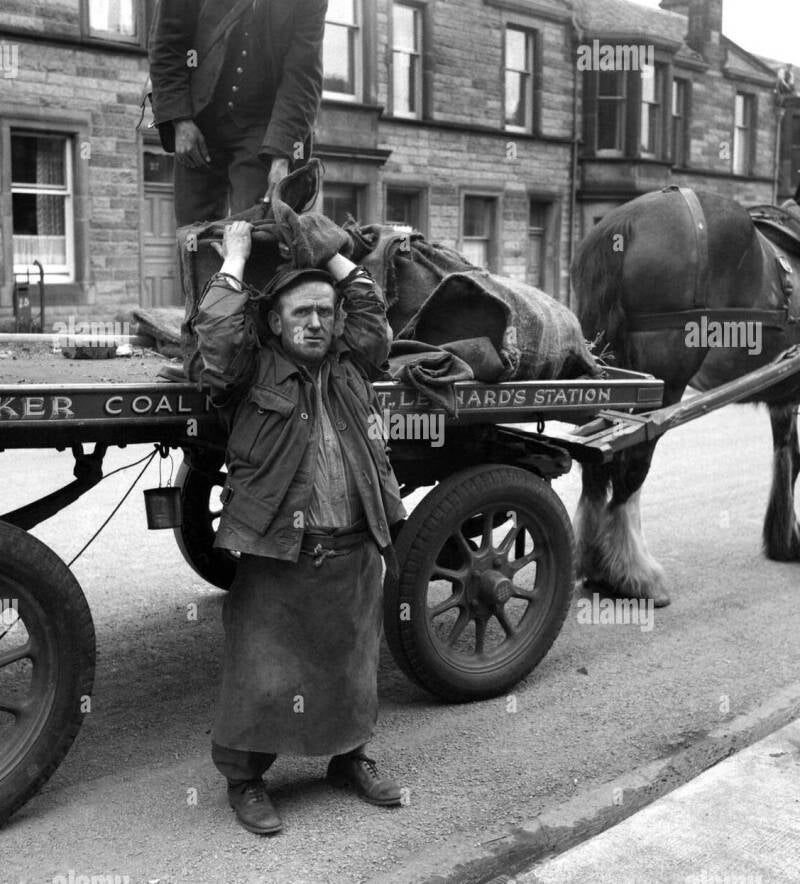
There were lots of horse-drawn delivery people in those days - the coal man, to mention one. He came by every week with lots of ‘one hundredweight’ bags of coal on his cart. Everything about him was dusty; his cart, his horse, his red face and himself.
Coal was the most common form of heating back then, but it was rationed, so people were limited in how many bags they could purchase in a week. As we weren’t very well off, mum would only buy one bag a week, anyway. In Britain, a hundredweight (cwt) was equal to 112 pounds.
Mum also bought a sack of “nutty slack”! What on earth was "nutty slack"? I hear you say. Well, it was a slang term for a cheap fuel consisting of coal dust (slack) and small lumps of coal (nuts). It was widely used in Britain, especially after World War II, because it was not rationed like other solid fuels. However, rationing was never mum’s main concern, it was lack of funds!
She was quite the expert at lighting fires and keeping them going, was my mum. She would start the fire with wood chips and lumps of coal; she even could make fire starters out of sheets of newspaper. This was an art form in its own class; she began by folding up the news sheets, then twisting them into a tight ball. The knack was finding small pieces of coal, placing them strategically on the paper balls, next she’d light the paper, fanning the small flames occasionally to get the coals to ignite. Then, once it was blazing merrily, she would pile on the nutty slack until it was stacked high up the fireplace. It looked as if she had completely obliterated the fire! But no, beneath it all, the fire smouldered and would continue until the evening when she would break up the now solid wall of slack and the fire would burst forth once more, throwing out precious heat in the living room. When the coal man arrived at our house, I would stand by his cart to watch him heave a bag of coal onto his back. In the wintertime he wore his warm, heavy work jacket and in the summer just a heavy-duty work shirt. But over those he also wore a “waistcoat”, but this waistcoat was not for show, it had a purpose and the back of it was made from solid, thick leather. This protected his back from the lumps of coal, which had sharp points sticking out of the hemp sack. These sacks by the way, were tied or twisted, at each top corner, which gave them two “ears”, one at each top end, providing something for the coal man to grasp. He would lower the back of the cart, jump on it and drag a sack to the edge, then he’d jump back down and position himself with his back to the sack, reach his arms up and back, grab the ears and heave the sack onto his back. Then he would walk up our path, bent over like an old man, through the gate and round to our coal shed, the door of which had been opened for him. In one fluid motion, he would pull the sack back over his head, at the same time, twisting the ears open and hurling the coal, out of its sack, into the corner of the shed! It was amazing to watch. Then he’d go back for the nutty slack and repeat the process. I wonder how many times in a week he would perform this arduous task, and what state was he in physically, after years of performing this daunting job, day in day out, five days a week?
One trader who didn’t use the horse and cart as a mode of getting around to distribute his wares, was the vegetable man, or “Greengrocer” to give him his official title. He must have been more “well off” for he had a small delivery van and came around about once or twice a week. Mum would always go out to buy potatoes and our week’s supply of vegetables from him. To me it seemed she spent hours with him, chatting away about this and that, taking ages to choose the cabbage, cauliflower and other veggies. She would feel them and prod them, satisfying herself there were no rotten bits that she’d have to cut off!
I mustn’t forget the fishmonger! He came once a week, also in a small van. His wares were subject to availability from the fishing boats, so sometimes he had cod or haddock or now and then, a nice piece of hake. I hated the smell coming from his van, I still do not like the smell of uncooked fish. How did mum know these tradesmen had arrived in our road? They blew their horns loudly as they slowly drove up and parked halfway.
Then there was the milkman! He used a horse-drawn wagon to carry his crates of milk until at least after the war ended and rationing restrictions began to ease up, which was around 1954. Whenever I think of the milkman, I can still see him with his uniform of white jacket over black trousers and tie, and a peaked cap, usually white and black. He was always clean, neat and tidy. He would be up at 4:00 am, cycle to the dairy, and be out on his round to deliver the milk before anybody else arose. If you were awake early you could hear him coming, the clip clop of the horse’s hooves on the road, the crates of milk bottles rattling and clinking in the back of his cart.
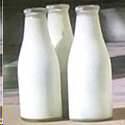
Milk came in one-pint glass bottles and was delivered daily, until it also was rationed. Three pints a week was the allotted amount. Imagine a family of four having to get by with only three pints of milk a week! My mum could put all of that in the amount of tea she drank in a week! There never was fresh milk available in the shops. The milk we had delivered was pasteurized (lightly sterilized), so was regarded as “fresh”.
It was whole milk, and one could see the level of cream at the top of the bottle, which would start to form after bottling.
Hence the expression “the cream always rises to the top”! Before opening it, mum would gently shake the bottle to ensure the cream was evenly distributed. Some folk would carefully remove the cream before shaking and use it to pour over fruit or pie or even give it a whip. As can be imagined, this left the rest of the milk watery and lacking substance when needed for breakfast.
In the 1940’s, during and after the war, the milk bottle tops were made of a stiff cardboard with a perforated circle in the middle, which could be pushed out so that a straw could be inserted for drinking the milk. This practise was used mainly on the 1/3-pint sized bottles, that were distributed to the schools. The children would be issued with a straw as well as the milk, to make it less messy when they drank it. But another ingenious use of these cardboard tops became very popular.

They made great “bobbins” for making pom-poms! Two were required for the task, so after they were washed and allowed to dry, the middles were pushed out, and the remaining pieces were placed back-to-back. Et voila! A bobbin! A large ball of wool was needed as you didn’t want to have to join two ends together. Then you would start to wind the wool, neatly and evenly, from the edge of the circle over and through the hole in the middle.
This was a continuous motion moving around the circle, on and on until there was no more hole! Now came the tricky part – as a good pair of scissors was needed – not too large. Using the scissors, cutting was started, carefully through the wool on the outer edge, between the two discs, all the way around! When done, the wool bundle was tied tightly with a length of wool; that done the cardboard pieces could be pulled off and the wool fluffed up with the fingers until a perfect pom-pom was formed.

In the city of Liverpool, the milk that was delivered was mainly “sterilised”, or “steri”, as the locals christened it. Which basically meant the milk had been boiled, apparently to quite a high temperature, to kill any contaminants such as bovine tuberculosis. This was quite prevalent in the U.K. and had been traced to cows and by association, raw milk. This higher and longer heating of the milk more than in pasteurized, gave the milk a caramelized, burnt flavor.
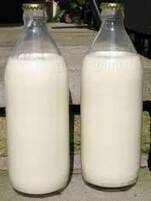
It came in taller bottles with crimped, metal tops, like the ones found on beer bottles today. People either loved or hated it! My mum would not have the stuff in the house! She complained it did terrible things to the flavour of the tea. Tea was sacrosanct to my mother! If there was one thing I learned, it was never muck around with mum’s cup of tea! However, “steri” did have its advantages; it was great in rice pudding and if it was used to make custard, it was heavenly. Apparently, it also worked well in coffee, but at that time, coffee was never drunk in our house - "too expensive!" pronounced mum, the inveterate tea drinker.
Another reason for sterilisation, was because once heated to a high temperature, milk didn’t sour and had a longer shelf life. Fridges were unheard of for ordinary folk, and milk would turn sour quite quickly; even in winter it could turn within a week. So, nobody ordered more than they needed. In summer, a pint of milk could sour before nightfall! Another expression for milk turning sour was “the milk is off”! How did folk prevent this from happening? Some people bought tinned milk, which could be used in tea, (more about that in a minute), but our mum would place the bottle in a large pan filled with cold water and put it on the floor of the pantry, (a large cupboard-cum-small room off the kitchen, which in most houses, could stay quite cool, reason being it had no windows and did have a concrete floor), replacing the water every few hours. Some houses had cellars, areas beneath the building which never seemed to heat up.
One thing that people knew they couldn’t do, was to leave the bottle of milk on the doorstep too long; the birds loved to pierce the top with their beaks and help themselves to that delicious cream!
Everyone had the obligation to rinse the bottles when they were empty and put them out on the doorstep, for the milkman to collect on his rounds. They were taken back to the dairy and sterilized, ready for reuse. And so it was, day in day out for many years.

Earlier on I mentioned tinned milk. Well, there were two kinds of milk that came in cans. Evaporated and condensed. Evaporated meant it had had the water removed, again using heat; so it was something like sterilised, but not burnt tasting and it was unsweetened.
Condensed milk now, it was evaporated too, but it had sugar added to it, which made it thick, creamy and sweet. Yummy! “Evap.”, as evaporated milk was called, would be added to a dish of fruit or a slice of pie, but condensed milk, “connie-onnie” went on bread for sandwiches, (the Liverpudlians called them butties) or was used in baking.
One other group of visitors to our road was the Gypsies, or to use the correct term: Roma or Romani. This group of people have an interesting history, but I will not elaborate on that in this story. They would come around about once a year, telling fortunes and selling pegs and other odd items that they had made. They too had a horse and cart. The first time they appeared I was playing out in our road, I knew nothing about them, but I watched as they went from door to door, knocking and waiting for someone to answer. Not many doors were opened to them! When they reached our house, I noticed that mum didn’t answer the door. Puzzled, I watched as they next went to our neighbours; I knew my mum was in, why wasn’t she opening the door? Then I caught sight of her frantically beckoning me from the bedroom window; she wanted me to go in. I ran up the path, through the gate and in through the back door. She grabbed me by my arm and whispered for me to be quiet! Then she crept back to the front bedroom, peered out of the window, taking care to keep out of sight and stayed there watching the Gypsies until they disappeared around the corner and out of our road. She was obviously perturbed by them, and her behavior frightened me and as a result the seeds were set; for years to come I would be frightened every time I saw the Gypsies coming.
As soon as they appeared in our road I would run into the house as fast as my legs would carry me. When I was still very small, I would run and hide under a bed or in a cupboard! I listened to grownups talking about them. It seemed that if one opened the door to a Gypsy and refused to buy their wares or cross their palm with silver when they told your fortune, then they would put a curse on you and your house! It was said too, that they had uncanny powers of clairvoyance; that they could tell you your past and some of your future. They were dark skinned, swarthy even; all with brown eyes and dark hair. They were always poorly dressed and looked like they needed a good square meal and some of them, a good wash!

At school, I learned that sometimes their home was a colourful caravan pulled by a horse and how they travelled from one end of the country to another in this flimsy caravan that had no modern conveniences. They would camp in a farmer’s field or even on a village green – always causing consternation among the locals.
All these colourful and interesting characters filled my life in the early years that I was growing up in Spring Gardens.