

OUR CUPS OVERFLOW
Water, water everywhere
Nor any drop to drink
Water, water everywhere
And all the boards did shrink
So runs a verse from a very old poem, “The Rime of the Ancient Mariner” By Samuel Taylor Coleridge.
About forty years ago, when we were still living in Calgary, a controversy raged over the installation of water meters and every time the subject came up I was reminded of the experiences Don, my hubby, and I, had in 1979 when we went to live in Doha, Qatar. Qatar is a small Arabian country – a thumb shaped peninsular jutting out into the Arabian Gulf.
We lived in one of four large houses in a compound surrounded completely by a high wall. Outside of each house was a very large, rusty, water-storage tank. From this tank ran a series of pipes around the side of the house and up to a smaller tank, situated on the flat roof; and the water was transferred through them by means of an electric pump. A very small pump! Plus, the water pressure in the house depended entirely on the level of water in the small tank.
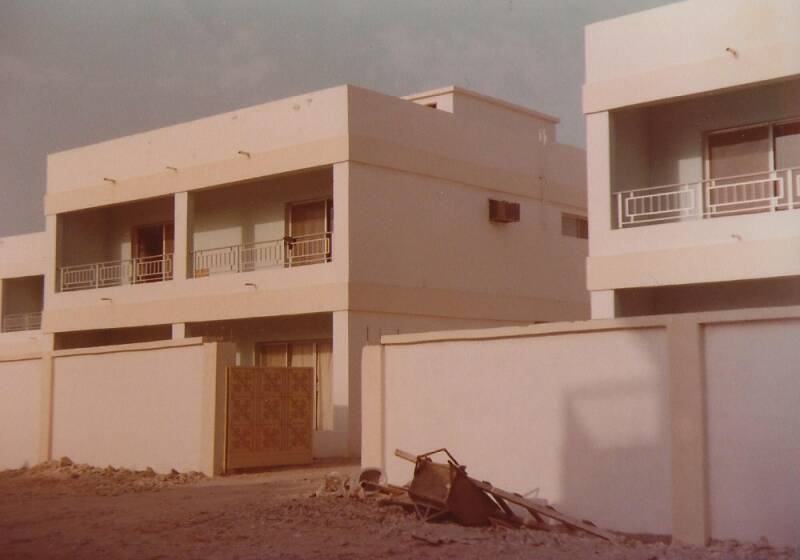
Our house on the left. You can see the high wall that encircles the compound. It obscures the windows on the ground floor. Which as we found out, was not a bad thing!
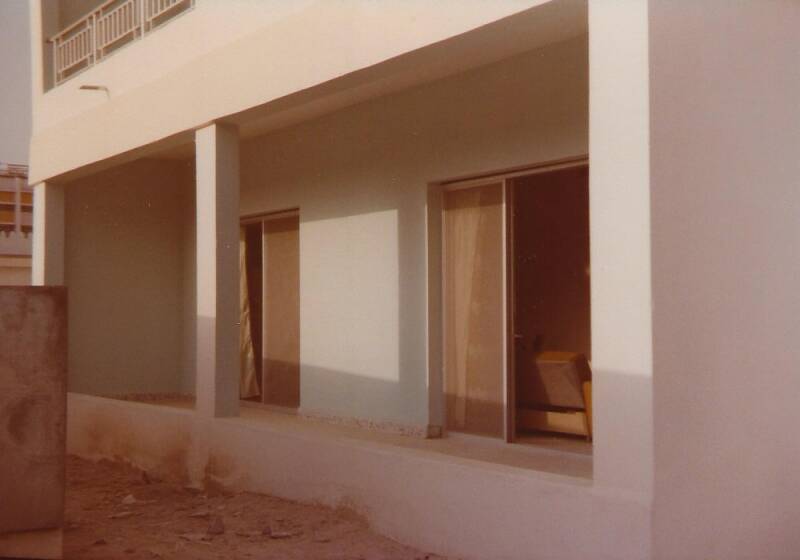
On the right, two sliding doors leading out from the living room.
The large tank held enough water to last about two days and every day for six days, a water bowser (tanker) would come around and refill it. This bowser held enough water to top up all four tanks, but if one household had been extravagant and the driver couldn’t be bothered to go back to the water depot for a top up and return a second time, then we could be out of luck. So, acting on Don’s advice, every day I offered the driver a small bottle of pop, coca-cola, 7-up or such like, to sweeten him up so he wouldn’t miss us out. Trouble was, all my neighbours had been given the same advice, so if he went to their houses first, by the time he got to ours he was looking decidedly fed up with pop.
They did have water mains in Doha, but ours was new property, and I am convinced that the Qataris threw up the buildings first and worried about mains and drains later – though I hasten to add that we were connected to the sewerage system!
So, how does a desert country with hardly any rainfall cope with providing a water supply? Qatar was fortunate to have ocean on three sides, so they used desalinated sea water. However, the treatment plants were expensive and Doha is built mainly on rock, It wasn’t easy to bury pipelines so there was the problem of transporting the water across the town, from street to street and house to house.
As we were expatriates from England and having taken running water from a tap for granted all our lives, this came as a shock to us and we had to do some quick adjusting.
Rule number one: remember to switch the pump on as soon as you climb out of bed!
I had to do laundry every morning – in the intense heat we changed our clothes about three times a day. If I didn’t remember, the small tank would run dry by noon and then it took forever to fill it again. If the water level in the tank dropped below the halfway mark, the water coming out of the tap was reduced to a trickle, and if it became too low it turned brown! There must have been about five inches of rust at the bottom of that tank.
Rule number two: Switch the pump off!
“Oh look!” I said to Don one day, “it’s raining.”
“Raining?” he said, “it only rains one day a year and this isn’t the season!”
We ran to the window – there wasn’t a cloud in the sky! We flew up two flights of stairs. Oh my Lord! The roof was awash – all that precious water wasted. I felt so guilty I never forgot to switch off the pump again. The man on the water bowser spent longer on filling our tank the next day, and I suspect he ran out before he got to our fourth neighbour! I wonder if he bothered to make two trips?
We couldn’t drink the water from the tank, so for drinking water and cooking, we had to buy purified water in bottles from the local supermarket. After a few weeks of this, we bought our own water filtering machine. It was large and served our purpose well. In the summer when the sun was at its highest, if I wanted hot water, I turned on the cold tap – if it was too hot I cooled it by turning on the hot tap! Strange I know, but the explanation is simple. The water in the small tank was connected to the cold-water pipes, but with the sun blazing down on the roof all day, it heated to almost boiling point. By noon, the temperature outside could be as high as 140 degrees Fahrenheit. In the bathroom we had another small storage tank with a water heater, which was connected to the hot water pipes. With the heater off, this small reservoir stayed reasonably cool. In the winter we reversed the process.
Friday was the Holy day of rest for Qataris, it being an Islamic country, so there was no water delivery on that day. I arranged my schedule so that I didn’t do laundry on Thursday and maybe Friday too. Plus we tried very hard to be frugal with our other uses of water. Thursday’s water delivery had to last two days! There came one Saturday that the thing we most dreaded happened. Our water man did not arrive. The level in the large tank was quite low and by noon we were frantic. Don decided he would have to visit the “Ministry of Water”.
Don’s knowledge of Arabic was limited and the Forman at the Ministry didn’t speak much English. “Maffi Moy,” said Don, which he hoped would be roughly translated to mean “no water”. Well “Maffi fulus” meant “no money” so it was worth a try!
It took half an hour, but finally we realized that they understood our problem, as they brought out a bowser, and there followed an amazing pantomime of hands, Arabic and English as they tried to make us understand that we were to lead and they would follow as we led the way back to our house; Don’s Arabic having expired when it came to trying to explain where we lived!
So having successfully obtained the desperately needed water for that day, life carried on – the water bowsers arrived in a timely manner, the driver drank the coke or 7-up and all was well in our world – that is until “the day”! It was 6:00 a.m. when the sound of a pneumatic drill woke us from a delicious sleep. “What the hell….!” Exclaimed hubby. He flung himself out of bed and pulled the curtain back a smidgeon and peered out. What greeted him was several workmen digging a trench along the outside of the high wall. Despite being woken at such an unholy hour, we were excited. Perhaps, we thought, we were finally to be connected to the mains?
However, matters out in Arabia did not move at the speed they did in the West. Any enquiries of “When?” were always met with the response: “Buchra, Un Shala.” Which means “tomorrow, God willing.” Sometimes “tomorrow” never came or maybe God was unwilling, for when I left Doha to return to England in January 1980, the trench was still open to the skies with no sign of pipes.
When Don came home some months later for good, he told me that the pipes had been laid – but with one line branching off into the large, rusty, storage tank! Two years after it was built, the house was finally connected (sort of) to the mains!
When a person lives in Canada, it is hard to imagine a land completely devoid of trees. However, in Qatar they were trying desperately to grow them! But first they had to import topsoil in which to plant the trees. If the trees survived and grew, they would provide a much-needed wind barrier, especially in exposed areas. Inland the terrain was entirely flat – just sand for miles, and so vulnerable to the fearsome winds. It is winds plus lack of moisture, more that the hot sun, which creates a desert.
So, the people of Qatar had to prevent this topsoil from drying out and being blown away. For this they employed desperately poor expatriates from Sudan, Jordan and even as far away as India, who would work for pennies to sit all day and water the soil of the tree beds. They were using recycled sewer water - the stench was overpowering!
In a desert land you develop a healthy respect for water. In the West it has been taken for granted – and wasted. However, now we have to face the terrifying fact of global warming – no longer a possibility – a fact! Here on Vancouver Island we hardly ever see snow up on our mountains. We no longer get rain during the summer months; no downpours just a sprinkling. Even in the winter months we don’t see as much rain as was customary and in Alberta the icefields are melting away. This is happening through all of Canada. Plus we are experiencing hotter temperatures than were ever known during the summers. As a consequence, every year we are subjected to water restrictions and the rivers and creeks are dry! Forest fires, hurricanes, tornadoes, flooding in some parts of the world. It is all very daunting and I think we could be facing a future of desert landscapes where it was once lush green, and possibly desalinated water!
In Canada, an average of 40% of households connected to mains are metered, and the provinces with the highest percentage are Alberta and Manitoba, with 58% to 62%. That’s not really enough given the predictions of what could happen if the natural supply of water gets less and less. In Quebec the percentage of metered homes is a shocking 10%, while parts of Atlantic Canada and specific regions like Metro Vancouver also historically lag in universal residential metering. We have to increase the number of households on meters to a higher percentage nationally, before the problem becomes dire.
Water is necessary to sustain life, but unless we take steps to preserve it, we could end up like the Ancient Mariner, with “water, water everywhere, nor any drop to drink!”